
“It’s easy to say ‘work smarter, not harder,’ but Barbara Oakley actually shows you how to do just that, in a fast-paced and accessible book that collects tips based on experience and sound science. In fact, I’m going to incorporate some of these tips into my own teaching.” — Glenn Harlan Reynolds, Beauchamp Brogan Distinguished Professor of Law, The University of Tennessee
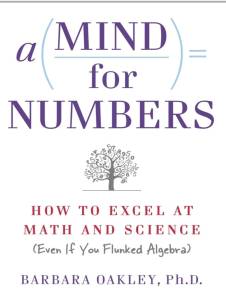
A Mind for Numbers / Barbara Oakley, Ph.D.
How to Excel at Math and Science
Even if You Flunked Algebra
English. 269 pages
Study and Test-taking skills. Memory Improvement. Study skills. Academic.
Whether you are a student struggling to fulfill a math or science requirement, or you are embarking on a career change that requires a new skill set, A Mind for Numbers offers the tools you need to get a better grasp of that intimidating material. Engineering professor Barbara Oakley knows firsthand how it feels to struggle with math. She flunked her way through high school math and science courses, before enlisting in the army immediately after graduation. When she saw how her lack of mathematical and technical savvy severely limited her options—both to rise in the military and to explore other careers—she returned to school with a newfound determination to re-tool her brain to master the very subjects that had given her so much trouble throughout her entire life.
In A Mind for Numbers, Dr. Oakley lets us in on the secrets to learning effectively—secrets that even dedicated and successful students wish they’d known earlier. Contrary to popular belief, math requires creative, as well as analytical, thinking. Most people think that there’s only one way to do a problem, when in actuality, there are often a number of different solutions—you just need the creativity to see them. For example, there are more than three hundred different known proofs of the Pythagorean Theorem. In short, studying a problem in a laser-focused way until you reach a solution is not an effective way to learn. Rather, it involves taking the time to step away from a problem and allow the more relaxed and creative part of the brain to take over. The learning strategies in this book apply not only to math and science, but to any subject in which we struggle. We all have what it takes to excel in areas that don’t seem to come naturally to us at first, and learning them does not have to be as painful as we might think.
https://gmworldbook.com/wp-content/uploads/2024/02/55518-a-mind-of-numbers.pdf
Barbara Oakley PhD
I work at Oakland University as a professor of engineering. I started studying engineering much later than many engineering students, because my original intention had been to become a linguist. I enlisted in the U.S. Army right after high school and spent a year studying Russian at the Defense Language Institute in Monterey California. The Army eventually sent me to the University of Washington, where I received my first degree’a B.A. in Slavic Languages and Literature. Eventually, I served four years in Germany as a Signal Officer, and rose to become a Captain.
After my Army commitment ended, I decided to leave the Army and study engineering so that I could better understand the communications equipment I had been working with. Five years later I received a second degree: a B.S. in Electrical Engineering. In the meantime, I worked several fishing seasons as a Russian translator on Soviet trawlers up in the Bering Sea. I wrote a book about that experience in ‘Hair of the Dog: Tales from a Russian Trawler.’ I also spent a season as the radio operator at the South Pole Station, where Philip and I met. (We were married as soon as we got ‘off the ice,’ in New Zealand.) With the B.S.E.E. degree in hand I settled down and spent three years working as a instrumentation and controls engineer at a laser research and development firm near Seattle.
We moved to the Detroit area in 1989. I worked for Ford briefly, and then began doing consulting and attending Oakland University part time while our children were small. I received a M.S. in Electrical and Computer Engineering in 1995, and a Ph.D. in Systems Engineering in 1998. I was hired after my graduation to continue on as a professor at Oakland University.
Since then, I’ve become interested in learning about people and places using an out-side-the box perspective–as you can tell from my books. I feel compelled to explore ideas and concepts in writing–thank goodness I have a family that’s forgiving of my compulsion!

Yorum bırakın