
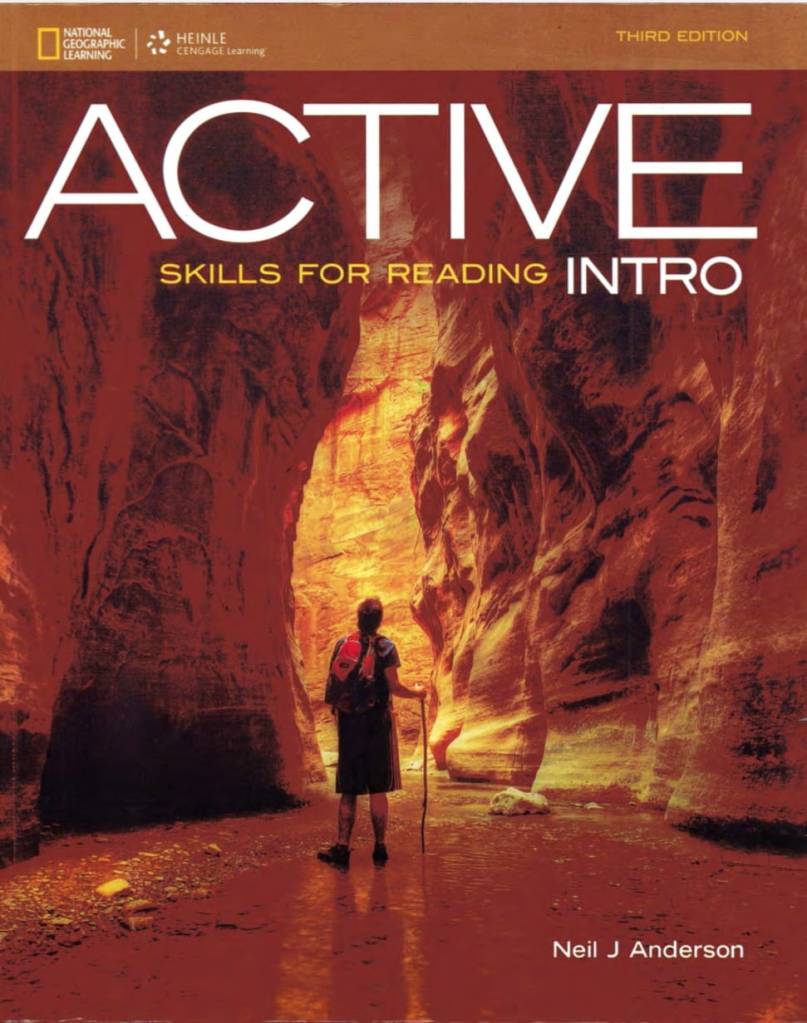
Active Skills for Reading INTRO
National Geographic Learning. Heinle Cengage Learning.
Third edition. Neil J. Anderson
English. Reading.
179 pages. 2013
What Is ACTIVE Reading?
ACTIVE reading is an approach to reading, advocated by Neil J Anderson, that focuses on the following elements:
A = Activate Prior Knowledge
Activation of background knowledge improves reading comprehension.
Getting Ready and Before You Read sections elicit learners’ prior knowledge, and generate interest in the topic, through use of visual prompts and questions
C = Cultivate Vocabulary
Vocabulary plays a crucial role in the development of reading abililty
Vocabulary Comprehension sections in each unit examine vocabulary items encountered in the main reading passage.
Vocabulary Skillsections provide learners with explicit skills-based instruction in how to learn, process, and decipher new vocabulary.
T = Think About Meaning
In addition to testing for comprehension, the ACTIVE approach encourages learners to think deeply about the meaning of the text
Check Your Understanding questians focus learners on the main ideas and key details of the text.
Critical Thinking questions require learers to ga beyond reading comprehension to analyze each text and the author’s intent.
I = Increase Reading Fluency
Conscious development of reading rate and comprehension are key ingredients in. building reading fluency.
Tips for Fluent Reading (pages 8 and 9) encourage learners to become more aware of their own reading habits.
Four Review Units reinfarce learners’ use of strategies and provide additional reading fluency practice.
V = Verify Strategies
Learners are encouraged to be aware of what they are daing and why they are doing it, as they read
Reading strategies are presented in the Reading Skill sections, the Vocabulary Skillsections, and the Real Life Skill section in each unit.
Self Check sections in each Review Unit require learners to monitor the effectiveness of their own use of strategies.
E = Evaluate Progress
Both qualitative and quantitative evaluation of learners’ progress is advocated.
The Reading Rate Chart and the Reading Comprehension Chart allow learners to plot their achievements in building reading fluency.
What Do You Think? sections pravide opportunities for learners ta show comprehension of the unit theme, through verbal ar writen discussion.
This book is dedicated to the students and teachers who have used ACTIVE Skills for Reading over the past 10 years. Since 2002/2003 when the first edition of ACTIVE Skills for Reading was published, thousands of students and teachers have used the book. I know that I had no idea that the series would be this popular and that we would reach the stage of publishing a third edition.
The pedagogical framework for this series is as viable today as it has ever been. As students and teachers
use each of the elements of ACTIVE, stronger reading will result.
My associations with the editorial team in Singapore continue to be some of my greatest professional relationships. I express appreciation to Sean Bermingham, Derek Mackrell, and Andrew Robinson for their commitment to excellence in publishing. I also express appreciation to Jenny Wilsen and John Mum for their commitment to helping the third edition be stronger than the two previous editions.
Neil J Anderson
https://gmworldbook.com/wp-content/uploads/2024/02/4ffef-active-skills-for-reading.pdf

Yorum bırakın